20040228
=======
The 228 Incident on Feb. 28, 2004 ……
The 228 Incident
By Lee Shiao-Feng
On Aug. 6 and Aug. 9, 1945, US atomic bombs were dropped on Hiroshima and Nagasaki, respectively. One week later, Japan declared an unconditional surrender. The Japanese surrendered to the Allied Forces and renounced their claim to Taiwan. Chiang Kai-shek, the chairman of the Nationalist government in Nanking, accepted the surrender of the Japanese military in China. It was against this backdrop that Chiang sent troops to take over Taiwan. Actually, it was a temporary military occupation. But at the time everyone called it "retrocession."
The "retrocession" was carried out without obtaining the agreement of the residents of Taiwan. But, at the time most Taiwanese maintained a welcoming attitude toward it. They welcomed the Nationalist government from China with the enthusiasm not seen in other areas of China.
While the people of Taiwan joyfully welcomed the retrocession and the new "mother country," their new rulers acted like conquerors.
First, the Nationalist government established the "Taiwan Provincial Executive Office" as the ruling institution -- a system different from what was in place in other Chinese provinces. This institution held executive, legislative, judicial and military powers, as if it were a replica of the Japanese governor's office and as if it were extending the colonial system. This "new governor's office" monopolized all resources -- from political to economic to social, which laid the roots for the 228 Incident to take place one year and four months later.
Following the Nationalist government takeover, people were quick to realize it was establishing a total political monopoly, where perks and privileges went to a small number of people, there was widespread corruption and where the leadership was inexperienced.
While the Nationalist government paid lip service to offering opportunities for political participation by the Taiwanese, in reality it used the excuses that "Taiwan has no political talent" and "Taiwanese compatriots do not understand the national language" (Mandarin) in order to exclude many well-educated Taiwanese from mid-level and top posts. The important jobs were mostly given to people from China. Mainlanders essentially replaced the position of "the ruler" held by Japanese during the colonial era, which left Taiwanese intellectuals feeling disappointed.
Most unbearable to the Taiwanese was the corruption. At the time, in the private sector, people referred to the "takeover" (of Taiwan) as a robbery. The "post-robbery" politics and corruption gave the people of Taiwan the experience of their lives for the next 50 years.
On the economic front, the same kind of monopoly took place. The two reigning economic institutions at the time were the Trade Bureau and the Monopoly Bureau. The Provincial Executive Office continued the government-monopoly system of the Japanese, giving the Monopoly Bureau full control over the sale of goods such as matches, cigarettes, liquor and camphor, as well as weights and measures. The Trade Bureau monopolized the procurement, sale and export of industrial and agricultural products. The lives of the Taiwanese became even more difficult and impoverished.
As a result of an economic downturn and a shortage of daily necessities, theft became prevalent. Even more painful to the people was the fact that the troops stationed in Taiwan were undisciplined and often bullied people. These soldiers were the troops from the "mother country" who had been enthusiastically welcomed by the public only a year ago. In the second year after the Nationalist government took over Taiwan, the crime rate became a serious problem, climbing 28-fold. In 1946, confrontations between the general public and the military and the police became more frequent. These incidents all had the potential of escalating into massive riots.
History takes a different route
Taiwanese had thought that China -- due to a common written language and race -- was the mother country they could rely on. It wasn't until after China descended on Taiwan that they discovered their idea of the "mother country" couldn't be further from the real China. They simply couldn't adjust to the change.
Taiwan and China had developed very differently. The history of Taiwan is filled with characteristics of an oceanic culture, with a vibrant island commerce. In particular, after Liu Ming-Chuan succeeded in pushing for new governance in Taiwan, and having gone through 50 years of Japanese rule, Taiwan had far surpassed China in terms of the level of development. The gap between the two societies was very significant, not to mention the differences in values and ways of life. The forcible "unifying" of two such fundamentally different societies made it easy for frictions and conflicts to occur.
Incident ignited by cigarettes
Late in the afternoon of Feb. 27, 1947, six agents of the Monopoly Bureau's Taipei branch, including Fu Hsueh-tung, were investigating the sale of smuggled cigarettes on Tai-ping-tung, which is today's Yenping North Road.
They caught middle-aged widow Lin Chiang-mai illegally selling cigarettes in front of the Tien-ma Tea House (located near the intersection of today's Yenping North Road and Nanking West Road). The agents tried to confiscate Lin's cigarettes and money, but she refused and begged for mercy. The agents hit Lin on the head with their gun barrels, making her head bleed, and she passed out.
Bystanders became enraged and protested to the agents. The agents ran away, firing upon the crowd as they did so. A spectator, Chen Wen-hsi, was hit (and died the next day from a gunshot wound). The public became even more irate, besieging both the police and the military police headquarters, demanding that the culprits be turned over for prosecution, but their demand was not met.
Taiwan stood up for itself
On the morning of Feb. 28, people went to the Monopoly Bureau to protest and then charged into the bureau's Taipei branch office. They tossed documents, files and other items out into the street and burned them. Three of the office's clerks were beaten (some say one of them died). In the afternoon, a crowd gathered in the square in front of the Provincial Executive Office to protest and petition the government.
Military police on the balcony of the office opened fire on the crowd with machine guns, killing or injuring several dozen people. By then, things had gotten out of control. The entire city was restless -- shops closed, plants shut down and the students walked out of their classrooms to protest. The Garrison Command Headquarters declared a state of emergency.
After some young people went to a radio station (situated at the present site of the 228 Memorial Museum) on March 1 to broadcast to all of Taiwan about what had happened and urge people to rise and respond, things began to escalate across Taiwan. Riots occurred in all the major cities and towns. Angry mobs attacked police stations and government offices, attacking mainlanders, to relieve the anger built up over the past year.
General Chen Yi, the governor of Taiwan, also declared a state of emergency, and the police and soldiers fired upon the people to put down the unrest. Both sides suffered injuries and deaths. Young men, students and retired soldiers organized themselves in an attempt to take control of the weapons and arsenals of the military and police. But they were mostly inexperienced groups of people who were acting on the spur of the moment.
The "27 Brigade" (in honor of Lin's Feb. 27 beating) -- active in the Taichung vicinity -- was better organized. Ferocious conflicts took place at Shuishang Airport between soldiers stationed at the airport and militias comprised of Aboriginals from the Tzou tribe and Han people. Near the train station in Kaohsiung, some students and soldiers also clashed.
On March 1, officials and provincial council members organized a committee to investigate the bloodshed and deaths. They sent a delegate to meet with Chen Yi and suggest the establishment of a "228 Incident Committee." Chen gave his word and, in a radio broadcast at 7pm that day, he declared that: one, the emergency decree would be lifted immediately; two, those arrested would be released; three, soldiers and police were now prohibited from opening fire and four, the government and the private sector would jointly organize a committee to investigate what had happened.
On the afternoon of March 5, the 228 Incident committee approved its organizational guidelines, which included the goal of "reforming the administration of Taiwan Province." The legislative councils of cities and counties throughout Taiwan became branches of the committee, demanding political reforms.
Chen paid lip service to the committee's demands for political reforms, declaring that any member of the public could express his or her views through the committee and he would try his best to improve the situation. However, he also sent a telegram to Nanking asking for military backup.
Chiang took the words of military and political intelligence personnel in Taiwan and completely ignored the petitions and suggestions of the representatives of the private sector. He decided to dispatch more troops. Upon receiving Chiang's order, the 21st Division of the Nationalist Army led by Liu Yu-ching departed for Taiwan.
The arrival of the military
Late in the afternoon of March 8, the troops landed in Keelung. Laborers who were working on the dock at the time were shot down by the soldiers. On March 9, the 21st Division entered Taipei and then headed south. There were crackdowns and massacres everywhere. The 228 Incident Committee was declared an illegal organization and ordered to disband. Many of the social elite who had attended committee meeting became targets of the military crackdown.
During this time, individuals who had participated in the riots and rebellions were arrested and killed, as were many of the social elite who had never taken part. Privately-owned newspapers and magazines were shut down on Chen's orders .
On March 20, the authorities began the so-called "Ching-hsiang" ("to clean up hometowns") campaign. They asked people to hand over weapons and turn in "crooks" or face prosecution themselves. During this campaign, many people were arrested and executed, most without public trials. There is no accurate count of the total number of people killed or injured during the 228 Incident, however, the most frequently mentioned number is between 10,000 and 20,000.
Wounded orphans of Asia
What the 228 Incident brought for Taiwan was much more than just the tragic break-up of families and a huge death toll. It has had an everlasting impact on politics and society in general. On the one hand, the character of Taiwanese people became seriously twisted. Taiwanese who had always been under an alien colonial rule for decades now became even more humbled and self-demeaning. They took on a slavish character in order to ensure their personal safety, never daring to resist their rulers.
On the other hand, the people both feared and were disillusioned by politics. Such paranoia and indifference toward politics suited the one-party totalitarianism of the Chinese Nationalist Party (KMT) but was bad for the development of a democracy.
The elimination of the Taiwanese social elite also facilitated the KMT's governance. Many of the elite who managed to survive the ordeal no long wanted to have anything to do with politics. The nature of local politics drastically changed as gang members, corrupt local politicians and unscrupulous members of the local gentry and business communities assumed a dominant role.
Two years after the 228 Incident, the KMT's Republic of China went into exile in Taiwan after being defeated by the Chinese Communist Party. Although the "Republic of China on Taiwan" imposed 38-year long state of emergency, securing its rule through a "White Terror" campaign, Taiwan managed to escape plundering by China and to remain independent of the Beijing regime. It began to develop its own economy, trade, industries and businesses, becoming one of the so-called "four little dragons" of Asia.
Through industrial and business development, social changes and cultural integration, the ethnic rivalry seen during the 228 Incident no longer exists. With Taiwan's situation in the international community becoming increasingly difficult, and given China's unrelenting efforts at coercion, a stronger sense of identity and cohesion should be forged among the various ethnic groups in Taiwan.
Will history repeat itself?
Today, the White Terror is a thing of the past. Politics have become relatively democratized. It would be virtually impossible for conflicts similar to those of the 228 Incident to take place again. However, facing China's unification campaign, the history of the 228 Incident still holds a valuable lesson for all of us. In the so-called "retrocession" of Taiwan in 1945 was a "unification" of China and Taiwan. The 228 Incident was a side effect of this unification, caused by the enormous gaps between the Taiwanese and Chinese societies of the time, which made the two ill-suited to one another. Such poor adjustments are part of the pattern of resistance and suppression that results when those from a more backward culture try to impose their rule on those with a higher cultural development.
China is worlds apart from Taiwan in terms of its political system, social structure, economic accomplishments, legal structure, culture, life values and human rights protection. If Taiwan is "unified," one cannot help but fear a repeat of the 228 Incident.
Lee Shiao-feng is a professor at Shih Hsin University.
-----------------------------------------
On Feb. 28, 2004 ……
Historic Hand-in-Hand Rally to be held today
By Chang Yun-ping, STAFF REPORTER
More than 1 million people are expected to join hands in an island-long human chain today as a peaceful means of protest against China's military threat.
Organizers of the "228 Hand-in-Hand Rally" yesterday encouraged more people to come out in support of the event in the hope that this display of people-power would focus international attention on Taiwan's precarious relations with China, which has 496 missiles aimed at the country.
The event was originally aimed at bringing 1 million people together to form a 500km-long human chain from Keelung County in the north to the southernmost tip of Pingtung County. Due to enormous public interest, more than 1 million people have signed up to take part and the length of the chain has been extended to nearly 600km.
The chain will primarily run along National Highway No. 1 and partially along Highways No. 3 and No. 5, from Hoping Island near Keelung to Pingtung's Oluanpi.
The participants are expected to join hands at 2:28pm today.
"Our history is about to be written by ourselves. We use the softest approach in the hope of producing the biggest shock to build up our confidence and demonstrate the will of the Taiwanese people in the hope of changing China's attitudes," said Annie Lee, daughter of former President Lee Teng-hui, the national leader of the massive event.
Chief organizer Ng Chiau-tong yesterday called on people who have to work today to leave their offices for a minute and link hands with their colleagues outside. He said motorists should honk their horns to show their support.
Those who haven't yet signed up can just stop at any part of the designated route and join the line, Ng said, urging participants to bring cameras along.
The rally is a collaboration between the Democratic Progressive Party (DPP) and its partner, the Taiwan Solidarity Union (TSU), of which Lee is the founder, and is expected to bolster President Chen Shui-bian's re-election bid.
Prominent members of the pan-green camp are expected to take part in today's rally. Chen and Lee will join the line in Miaoli County. Vice President Annette Lu will take part in Hsichih in Taipei County, and the first lady, Wu Shu-chen, and her daughter, son-in-law and grandson will be at Taipei's 228 Peace Memorial Park, together with Taipei County Commissioner Su Tseng-chang.
Premier Yu Shyi-kun will join the chain in the middle in Changhua County, and Kaohsiung Mayor Frank Hsieh will take part in Kaohsiung City.
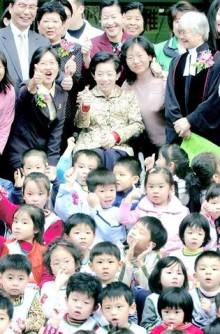
First Lady Wu Shu-chen (center) attends an event at a Christian church in Taipei's Wanhua District yesterday in preparation for today's ``228 Hand-in-Hand Rally.''
-----------------------------------------
On Feb. 28, 2004 ……
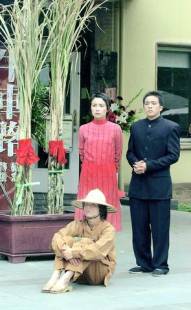
Dressing Up History
Actors appear in old-fashioned outfits yesterday at the opening ceremony of a farmer's exhibition at the Taipei 228 Memorial Museum.
-----------------------------------------
On Feb. 28, 2004 ……
-----------------------------------------
On Feb. 28, 2004 ……
Human rights trump sovereignty
By Ming Chu-cheng
Recently the Taiwan High Court, on grounds of "mistaken jurisdiction," rejected a lawsuit filed by Taiwanese practitioners of Falun Gong against former Chinese Communist Party leader Jiang Zemin and others. This has led to a controversy over whether Taiwan has the power to put another country's officials on trial.
What is most important in this is the dispute over which principle should take precedence -- human rights or national sovereignty.
From ancient times, nations have always been viewed as the primary unit in international politics. National sovereignty has also been viewed as sacrosanct since the 17th century.
However, the sanctity of national sovereignty has declined markedly since the end of World War II.
This change in attitude has followed progress in globalization.
The increase in the number of international treaties, the ascendence of international organizations and the rising role of multinational corporations have all been important factors in this development.
Most notable has been the emergence of trials that constrain the acts of war by nations. In the several thousand years of human history, war was always viewed as the supreme method taken by nations to realize their will.
Wars therefore had a quality of justice.
Whatever methods that were adopted by nations in war -- be they for the sake of victory or self-defense -- were basically considered reasonable.
After World War II, however, two international courts were set up.
The Nuremberg and Tokyo courts launched prosecutions targeting acts of war by Germany and Japan, as well as individual politicians and high-level military officers from the two countries who engaged in excessively cruel acts of war.
This opened a precedent for war crimes trials.
Over almost half a century, in view of the fact that civil wars in some nations have been excessively brutal, the international community has pushed further ahead with the concept and practical handling of war crimes.
For example, between 1992 and 1995, civil war broke out in Bosnia, which had broken away from former Yugoslavia.
The three feuding groups -- Muslims, Serbs and Croats -- adopted extremely cruel methods to slaughter each other and engage in ethnic cleansing.
The international community was shocked and sent troops to intervene and stop the civil war. A special tribunal for international war crimes was also set up under the UN. After more than 10 years of work, the leaders of the three groups or military officers responsible for the brutalities -- except for a few still on the run -- have been arrested and put on trial on charges of genocide, massacre and rape. In addition to generals from the three groups, those on trial also include former Bosnian Serb leader Biljana Plavsic.
In the late 1990s, in neighboring Serbia, president Slobodan Milosevic's advocacy of nationalism led to riots by ethnic Albanians living in the Kosovo area. Milosevic sent troops to suppress them.
At the same time, he adopted a policy of ethnic cleansing that resulted in massive casualties and led to armed intervention by NATO.
Milosevic eventually fell from power and was sent to the International Criminal Court in the Hague for a trial that continues to this day.
To cite another case, Augusto Pinochet, the strongman who exercised military dictatorship in Chile from the early 1970s to 1990, was ruled guilty by a Spanish court after he fell from power on account of his excessively brutal rule, which saw at least 3,000 of Pinochet's political opponents abducted, arrested or even assassinated.
In Southeast Asia, Cambodia was ruled in the 1970s by the Khmer Rouge, which within a few years butchered more than 1.7 million people -- 30 percent of the nation's population -- for political reasons.
After almost 30 years, the UN reached an agreement with Cambodia's new government last year and set up a special tribunal in preparation for a trial this year of political leaders responsible for the massacres during those years.
The cases mentioned above tell us two things.
One, national sovereignty is no longer sacrosanct. Human rights values have begun to override areas that before that were considered national sovereignty.
Two, over the past 20 years or so, the scope of the crime of genocide has not only involved wars between nations but has also entered the area of civil wars and even acts of government by nations.
National leaders who carry out genocidal policies under the banner of the nation should take note.
National sovereignty no longer serves as a protective umbrella for vicious government actions, which are subject to prosecution so that human rights and justice may be upheld.
Taiwan, which stresses building its nationhood on the foundation of human rights, should in fact safeguard people's rights more actively.
It should not evade the responsibility to uphold justice under a pretext of "no jurisdiction."
Ming Chu-cheng is a professor of political science at National Taiwan
University.
-----------------------------------------
On Feb. 28, 2004 ……
The real 'Great Wall' is democracy
In observance of the 57th anniversary of the historic Feb. 28 Incident, the 228 Hand-in-Hand Rally, organized by a civilian association and endorsed by the government, is scheduled to be held this afternoon.
At 2:28pm a human chain running between Hoping Island, off the northern tip of Keelung, and Oluanpi, in southern Pingtung County, will be formed as a democratic "Great Wall" to demonstrate the Taiwanese people's will for cross-strait peace and ethnic reconciliation. More than 1 million people are expected to participate in the largest demonstration yet in the nation's social movement.
Because the presidential election is only three weeks away, the timing of the rally will have a huge impact on the results of the campaign. Nevertheless, the broader implications of the event in terms of its contributing to the maturation of democracy should not be overlooked.
When Taiwanese people first earned the right to directly elect their president in 1996, the Chinese government launched missile tests in the Taiwan Strait with the aim of sabotaging the legitimacy of the election. Taiwan overcame China's military threat with strong determination, a brave heart and no fear.
In 2000, Taiwan's democratic consolidation was furthered by the nation's first-ever transition of power. After its five decades of authoritarian rule and "black gold" politics, the Chinese Nationalist Party (KMT) was forced to give up the presidency. A desire for change and reform are the main reasons for President Chen Shui-bian's victory.
Now, four years later, the Democratic Progressive Party has chosen the strategy of initiating a peace referendum as a mechanism for deepening Taiwan's democracy and as an attempt to establish a framework for peace and stability with the government in China.
The referendum issue has caused international concern because it plays into the concern that any referendum is an explicit action to pursue a de jure independence. The opposition here in Taiwan, without any legal grounds to object to the peace referendum, has encouraged people to boycott the referendum simply for electoral reasons.
The truth is that most of the international community and the opposition alliance here have failed to properly understand the pulse of the times in Taiwanese society.
Taiwan is probably the only Asian democracy to be founded with a purpose. The great phrases of that purpose still sound in every Taiwanese person's heart: "The people rule ... the people speak ... government by consent of the governed ... the future of the country should be decided by all Taiwanese through plebiscites."
All political parties and the leadership in this country should recognize the people's power and the people's will for a full-fledged democracy. The formation of a human chain on Feb. 28, 2004 is a gateway to peace and reconciliation.
After a decade of ambiguity on Taiwan's relationship with China, and in the face of Beijing's increasing missile threats and diplomatic saber-rattling, it is time for the 23 million people of Taiwan to speak up and ask for peaceful and equal treatment from the other side.
Moreover, because politicians have taken advantage of ethnic problems for political gain in the past couple of years, it is time for national reconciliation. Let there be no more ethnic problems. There is only a Taiwan problem. That is -- united we stand, divided we fall.
We should join hand in hand this afternoon to solve that problem. History books will record this monumental achievement not only because of what it means to the next generation but also because it represents a mission we pledge to complete.
Let's join together in this holy moment and show China and the world that the real "Great Wall" is not something made of stone, but rather something constructed on freedom and democracy.
-----------------------------------------
On Feb. 28, 2004 ……
Take three steps for nationalism
By Hsu Shih-kai
The 228 Hand-in-Hand Rally has received widespread coverage in newspapers and on TV programs. Former president Lee Teng-hui, the head of the organization promoting the rally, is promoting the event with particular vigor. President Chen Shui-bian and Vice President Annette Lu have also called on the public to participate.
We at Chen's Taichung-based campaign headquarters are also busy. I've received many phone calls from people asking how to participate in the rally. Our office sent out 800 invitations asking people to participate in the section of the chain for which I am responsible, hoping to find 400 who would actually participate; to our surprise, nearly 1,000 people signed up.
Ever since I started taking part in organizing the rally, I've been thinking about why Feb. 28 was chosen as the date for this massive rally. The following represents my personal understanding.
Since I believe that the 228 Incident is a very important collective memory for the Taiwanese people, and one of the factors in the formation of Taiwan's contemporary nationalism, I am obliged to offer my thoughts for discussion. I hope this article can encourage more people to join this rally to protect Taiwan.
Taiwan's history of the last century or so can be divided into two parts.
The period beginning with Japan's occupation of Taiwan in 1895 and going through the end of World War II is modern history; the period thereafter belongs to contemporary history.
The 228 Incident is the biggest and most profound event in the nation's contemporary history. It is not too much to say that this event has defined the nation's subsequent development.
The 228 Incident has become a decisive point in Taiwan's contemporary nationalism.
Under Japanese colonial rule, the people were suppressed, but gradually cultivated their own awareness.
Then the 228 Incident smashed China's pipe dream, helping Taiwanese people become aware of the distinction between themselves and the Chinese people, and more decisively strengthening the self-awareness of the Taiwanese people.
Then, in the 1990s, Taiwan's localization developed when China intimidated Taiwan through propaganda and military force, resulting in a great transformation of Taiwanese self-awareness into national identification.
At the same time, also starting from the advent of Japanese rule, Taiwanese ethnic groups adjusted their attitudes toward each other, as evidenced in the Wushe Incident in 1930, when Aboriginal people killed only Japanese, not Han people.
Provoked by the 228 Incident, self-awareness continued to grow. For example, faced with the strength of people with roots in China, other ethnic groups developed attitudes of mutual solidarity.
Then in the 1990s, when democratization was under way, the four main ethnic groups were encouraged to strengthen their identities while at the same time showing respect (not integration and assimilation) toward each other.
People's identification with the new nation and harmony inside the nation are two issues of great significance to Taiwan's contemporary nationalism. The 228 Incident began the process, which accelerated during the 1990s when Lee was president. It is meaningful that it is Lee who is behind this rally.
The historic significance of the 228 Hand-in-Hand Rally is that Taiwanese people, based on their national identification with Taiwan, will stand up to say "no" to foreign invaders -- namely China, which has said it will not hesitate to use military force to annex Taiwan.
Moreover, Taiwanese people joining hands will demonstrate harmony and solidarity among all ethnic groups.
Around 150,000 people participated in a demonstration in Taipei last September to call for changing Taiwan's official name. Nearly 200,000 people turned out in Kaohsiung last October to push for a referendum.
Along the same lines, we hope to mobilize 1 million Taiwanese to join hands and say "no" to China's missiles and its intention to use military force.
This is an expression of Taiwanese contemporary nationalism, the growing consensus of the need to say "no" to China and the great leap forward in national identification.
For the public to say "no" to China, there are three concrete measures to be followed.
First, stand up and join hands.
Second, vote for Chen, who advocates "one country on each side" of the Taiwan Strait, and help him push for a new constitution and eventual realization of the nation-building goal.
Third, vote in the "peace referendum" on March 20. Say "no" to China. Say "yes" to Taiwan. Taiwan's national security will then be ensured.
I call on everyone in Taiwan to participate in these three historic activities.
Let us push Taiwan's contemporary nationalism to its highest point and strengthen our sense of national identification.
Hsu Shih-kai is a co-founder of a group promoting the 228 Hand-in-Hand
Rally.
-----------------------------------------
On Feb. 29, 2004 ……
Taiwan’s day of solidarity
The nation came to a standstill
yesterday as an estimates 2 million people joined together along the length of
the country on the stroke of 2:28pm to protest China’s missile threat against
Taiwan and commemorate the 20,000 who died in a bloody repression sparked by
the 228 incident in1947.
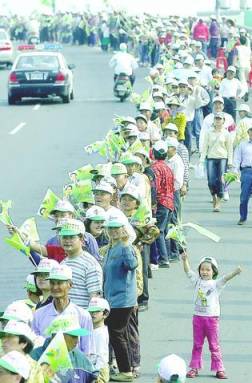
Residents from Kuantien Township in Tainan County join hands to form a long line on the Lungtien Bridge.
-----------------------------------------
On Feb. 28, 2004 ……

Although Sean Connery did not appear in person at the hand-in-hand rally, he was still present. Participants in yesterday's hand-in-hand rally wear kilts and Sean Connery masks.
-----------------------------------------
On Feb. 28, 2004 ……
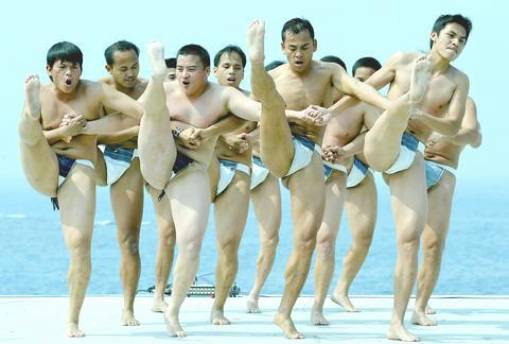
Aboriginal dancers perform to fend off evil spirits on the island of Hoping in northern Taiwan.
-----------------------------------------
On Feb. 28, 2004 ……
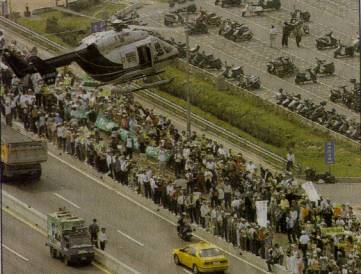
Participants in Taipei County cheer and wave as a helicopter recording the rally from above flies by.
-----------------------------------------
On Feb. 28, 2004 ……

Participants in the rally roll out sheets of colored cloth representing Taiwan's indigenous peoples as a symbol of ethnic solidarity on Hoping Island in Keelung, the starting point of the human chain.
-----------------------------------------