20040229
=======
228 memorial rally on Feb. 29, 2004 ……
President Chen hits conciliatory tone at 228 memorial rally
By Lin Chieh-yu, STAFF REPORTER , IN KEELUNG
In a speech marking the 57th anniversary of the 228 Incident yesterday, President Chen Shui-bian struck a positive and conciliatory tone, but also issued a thinly veiled warning to the nation that only the Democratic Progressive Party could continue to safeguard the people's right to determine Taiwan's destiny.
He highlighted the strengths shown by Taiwan's people in the years since the bloody uprising and subsequent suppression in 1947, stressed the common travails and destiny of all Taiwan's ethnic groups and declared that now was the time for all groups to "affirm their sovereignty" over the island.
"The people alone are sovereigns of this piece of land," Chen said. "Taiwan must always be its own sovereign."
The president made his remarks at a ceremony commemorating the nation's 2-28 Memorial Day on Hoping (peace) Island in Keelung City, northern Taiwan, where the former Chinese Nationalist Party (KMT) government landed its troops from China to begin its bloody suppression in 1947.
The 2-28 Incident was triggered after an armed agent of the Taiwan Tobacco and Wine Monopoly Bureau arrested an old woman selling contraband cigarettes on Feb. 27, 1947. Tens of thousands of people went to the streets to protest the KMT government's corruption and the protest finally became a riot. The government launched a military crackdown and thousands of people were killed or imprisoned in the following weeks.
Music played by trumpet and a string quartet began the solemn ceremony. Chen as well as the family members of some of the victims of the suppression observed a moment of silence for those who suffered in the 228 Incident.
Chen then led the family members in laying bouquets of flowers on a temporary monument on the stage in honor of the victims.
Earlier, the president had talked of how the 228 Incident had been a taboo subject for much of the last 57 years, but that he didn't see it as such. He called on people to reflect on the event with love, tolerance and introspection.
"With love for Taiwan, this nation and its people; with tolerance for history and each other; with introspection about the mistakes of the past and about ourselves; this should be our basic attitude toward the 228 Incident," he said.
Stressing ethnic harmony, Chen said that all the peoples of the island had suffered together, worked hard together and supported each other "under the same sun."
"Since we have come this far together, it should be said that the people of Taiwan are not forgetful, stupid or numb. Rather they are unrivaled in tolerance and courage," he said.
He reminded the audience that "for over 300 years, Taiwan was not a sovereign state and that the people of Taiwan were not the masters of their own household."
Nothing that Taiwan now enjoys, he said, was a gift from heaven or some occupying power, but the fruits of hard work on the part of the Taiwanese people.
Chen also paid tribute to China's role in Taiwan's culture and development, saying that affirming Taiwan's sovereignty did not mean "de-Sinicization."
-----------------------------------------
On Feb. 29, 2004 ……
Two million rally for peace
CLEAR MESSAGE: The organizers of the 228 Hand-in-Hand rally said that the event was a stunning success, and highlighted the nation's desire for peace
By Chang Yun-ping, STAFF REPORTER , IN MIAOLI
At least 2 million people yesterday joined together to form an island-long human chain to protest China's military threats and to give the world a clear message that the people of Taiwan want peace, not war, organizers of the rally said.
If the number is accurate, it would set a new record for the size of a demonstration in Taiwan. The participants of the human chain linked hands at 2:28pm yesterday and chanted slogans such as "Love Peace. Oppose missiles."
President Chen Shui-bian and former president Lee Teng-hui, the initiator of the rally, yesterday linked hands in Miaoli County as a symbol of their joint effort to promote Taiwan's independence.
"More than 1 million people have joined hands together to form a democratic great wall. This is a historic attempt by the people to show the world their love for Taiwan and the power that people have to write history with their own hands," Chen said at the rally yesterday.
Chen sent his regards to the participants, saying they had made this event possible, despite the doubts of some that the event would be successful.
Chen said the people of Taiwan had used the mildest, most joyful and dignified way to proclaim their solidarity and determination for peace to the world.
"However, this is just the beginning. We must continue our effort and cast referendum ballots on election day to maintain Taiwan's security," Chen said.
Lee said "seeing a big spectacle like this, in which more than 1 million people have come out to show their love for Taiwan, is the most touching moment I have ever witnessed in my life."
"Such is the power of the people, and this is a victory for the people of Taiwan," Lee said.
Although he appeared to be ailing slightly, Lee said that "the success of the 228 Hand-in-Hand Rally is the people's affirmation of Taiwan's national identity and a rejection of China's missile threats."
The massive human chain began in the north at Hoping Island near Keelung, and stretched 500km through 18 cities and counties in western Taiwan, ending at Changlung in Chiatung township, Pingtung County. The characters for "Hoping" and "Changlung" mean peace and prosperity.
Analyzing the event's influence on Chen's re-election prospects, Cheng Wen-tsan, director of the public affairs department at the Democratic Progressive Party's (DPP) campaign headquarters, said the extraordinary spectacle of the event would touched the hearts of many Taiwanese people, and these feelings will be trans-formed into support for Chen in the election.
"This is also a very big victory for the DPP, as the party has emerged to represent mainstream opinion, as shown by the success of this massive rally. At this moment, we want to ask where the Chinese Nationalist Party (KMT) has been?" Cheng said.
The event also attracted numerous foreign reporters to Taiwan to cover the human chain.
Estonian reporter Mart Laanemets said "through the event, people feel more and more that they are the bosses of the country, not politicians nor some party."
"When I saw a sign in the rally
which said `In 1991, Bush says yes to Baltic States, in 2004, Bush says yes to
Taiwan,' I, as a citizen of Estonia, felt very touched and proud and I hope the
Baltic experience will be successful for Taiwan as well," Lannemets said.
On Aug. 23, 1989, the three Baltic states, Lithuania, Latvia and Estonia formed a 2 million-person human chain covering 600km to protest the former Soviet Union's occupation. Following the human chain protest, the three countries successfully held referendums to declare their independence from Russia.
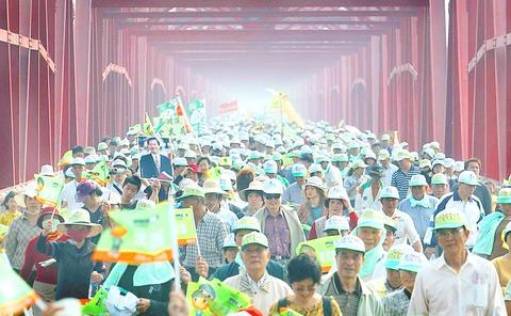
Nearly 10,000 Taiwanese gather on the old Hsilo Bridge during the island-wide human chain yesterday in Yunlin County, central Taiwan. The rally's supporters claim to have recruited at least 2 million people to form a human chain over 487km, extending from the northern port of Keelung to Pingtung County near the island's southern tip. Organizers and participants of ``Hand in Hand to Protect Taiwan'' hope the display of people power will focus global attention on the Chinese threat of nearly 500 missiles pointed at the nation.
-----------------------------------------
On Feb. 29, 2004 ……
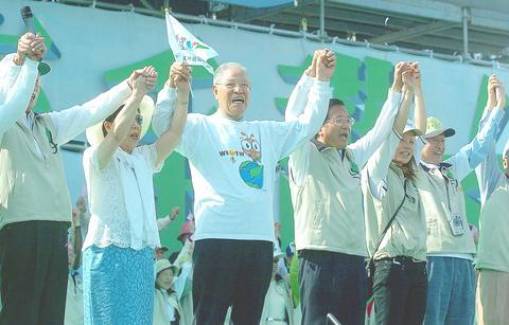
Yes to Taiwan
President Chen Shui-bian, third right, and former president Lee Teng-hui, third left, link hands at 2:28pm yesterday during the million-people-hand-in-hand rally in Miaoli County.
-----------------------------------------
On Feb. 29, 2004 ……
Human chain bears message of peace
DAY TO REMEBER: Joining 100 couples in a Mandarin love song, Premier Yu Shyi-kun called on voters to treasure the historic opportunity of the nation's first referendum
By Ko Shu-ling, STAFF REPORTER , IN TAICHUNG AND CHUNGHUA COUNTIES
About 100,000 people in Chunghua County and another 25,000 residents of Taichung County took part in yesterday's island-long human chain rally as a peaceful means of protest against China's military threat.
The highlight in Taichung was some 100 couples singing a famous Mandarin love song with Premier Yu Shyi-kun. In Chunghua County, participants carrying chrysanthemums gathered along the No. 1 Highway.
Chunghua County has earned its reputation for being at the heart of the nation's flower trade, and chrysanthemums are one of the county's biggest money-making products.
Speaking under the scorching sun in Taichung City yesterday after-noon, Yu told the couples holding hands with him and his wife, Yang Bao-yu, on Fu-in Road that he hoped Feb. 28 would from now on become a wonderful day to remember instead of a tragic day to mourn.
"The reason we're gathering here today is to let the world hear our voices," Yu said. "We'd like the international community to know that while we express our opinions in such a peaceful manner, China has over 500 ballistic missiles targeted at us and the number continues to grow."
Yu called on the 100 couples to also support the nation's first national referendum, which is scheduled to be held in tandem with the presidential election on March 20.
"The precondition for couples like you to be happy is that the nation has to be safe," Yu said. "Please treasure the historic opportunity of the first referendum. Cast your ballot and tell China and the world that you want peace and a life that is free from fear and intimidation."
Yu then rushed to Tatsoon township in Chunghua County, which was the midpoint of the 500km-long human chain.
Beating a peace gong provided by Tienho Temple, Yu, accompanied by Chunghua County Commissioner Wong Chin-chu, said that he hoped the sound of the gong would bring peace to the nation and that the sound of peace would spread from central Taiwan to the entire nation and then further to the world.
"The voice of one person, or 100 or 1,000 people, may sound small, but it makes a whole lot of difference if 1 million people come out to tell China that we want peace and we love this land," he said.
Citing the example of his walking out of the legislature on Tuesday, Yu took the opportunity to highlight the necessity and importance of legislative reforms.
"That incident showed the poor quality of lawmakers' questioning skills and the desperate need for reforms of the lawmaking body," Yu said.
He also called on the public to help President Chen Shui-bian win his re-election bid.
"Pushing for reforms is like growing a tree," he said. "Four years are simply not enough to push for reforms. Please support President Chen and Vice President Annette Lu in their re-election bid, so they can continue their unfinished mission."
Mark Cartwright, a 26-year-old English teacher from California, said that he came to yesterday's rally because he wanted to support "our president" and to support the society that is growing in this country that promotes freedom and diversity.
"This is an unprecedented event in Taiwan. I'm very happy to take part in Taiwan's history and culture and I hope that this momentum carries over to the election," he said.
Cartwright said that he respected what Chen has done for this country.
"[I respect] the sacrifices that he and our vice president have made for this country. I think that they can make many more positive reforms," he said.
Cartwright said that the referendum was bound to be controversial, because it was the nation's first on a national level.
"I believe that referendums are very important for democracy and I believe all of these questions will be worked out naturally," he said. "I support the referendum process as giving the people one more check over the government. Any democratic country will be a good example to show you why the people should have more control over the government."
Kelley Deon, a 30-year-old Canadian who has been teaching English in Chunghua for three years, however, expressed a different opinion.
"I think it's dangerous," he said. "I don't think things are that bad here."
Deon said he was afraid that Taiwanese might get what they want in the end, but would have to face some serious consequences.
"Not military but economical consequences," he said. "I think it's kind of scary and dangerous, but I still support it. I think that they have to try."
-----------------------------------------
On Feb. 29, 2004 ……
Just say `no' to Chinese missiles
This year, 228 Memorial Day saw a memorable and meaningful commemoration. Yesterday was a most touching scene as people of Taiwan formed a human chain from one end of the island to the other and then held up their hands at precisely 2:28 pm. Rather than feeling hatred and vengeful, the message that the people tried to get across to the world is their love and faith in their land and their longing for peace. This was despite the tragic massacres and bloodshed perpetrated 57 years ago by the totalitarian Chinese Nationalist Party (KMT) government, which served as a prelude to decades of white terror and the martial-law era.
Vice President Annette Lu put it best when, during the televised vice presidential debates held yesterday afternoon, she said "the tragedies of history can be forgiven, but they cannot be forgotten." The reason that the 228 tragedy should not be forgotten is the need to learn the underlying lesson.
The 228 experience taught us the importance of democracy and freedom and the ruthlessness of single-party totalitarianism. The people of Taiwan will never give up the fruits of democracy and embrace the dictatorship of Beijing. The sovereignty of this country must be safeguarded. The experience also revealed to us the evil of unchecked aggression. Therefore, the people of Taiwan must call for peace and say "no" to Chinese missiles.
Moreover, it is the wish of the organizers and the participants of the event to unequivocally teach not only China, but in fact the entire world the valuable lessons they have learned, so that Beijing can no longer deceive the international community about what is the will of the people of Taiwan.
The lessons of the 228 Incident are heartfelt by the people of Taiwan, and have become a part of their core values. This was reflected by the overwhelming and enthusiastic participation in the rally yesterday. It was estimated that 500,000 people would have been enough to form the human chain. At the end, according to the chairman of the rally, Huang Chao-tung, approximately 2.2 million people showed up. In many segments of the human chain, people had to stand in two, three, and even four lines. Moreover, thousands of Taiwanese from overseas flew back to Taiwan just to take part in this meaningful event.
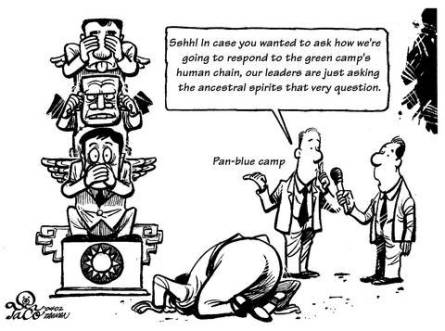
However, it is truly puzzling how some people, mostly supporters of the pan-blues, could paint the holding of the rally as inciting and manipulating ethnic rivalry and hatred. For example, as late as on Friday, the Miaoli campaign headquarters of pan-blue presidential candidate and KMT Chairman Lien Chan and People First Party Chairman James Soong was still talking about delivering a protest letter to President Chen Shui-bian and former president Lee Teng-hui, who were to join the human chain yesterday in Miaoli.
While it is true that in the past many people in Taiwan perceived the 228 Incident as a massacre of native Taiwanese by the ruling Chinese regime, people in Taiwan -- across all ethnic groups -- have come to realize that such an interpretation is an over-simplified depiction of the tragedy. Everyone who lives here is Taiwanese. In fact, it was the intention of the organizers to highlight the theme of ethnic harmony and unity through this rally -- as demonstrated by the participation of people from every ethnic group in the rally and the invitation of representatives from the five major ethnic groups in Taiwan to stand next to Chen and Lee in the event.
The 228 Incident should not be a taboo or a hush-hush topic -- the way it was treated before Lee openly issued an apology for it during his presidency. It is part of Taiwan's history that must be faced with love and tolerance, which is exactly what this rally was about.
-----------------------------------------
On Feb. 29, 2004 ……
Three events advance democracy
By the Liberty Times
On Feb. 20, the Central Election Commission published the names of the presidential and vice presidential candidates. The election campaign officially began the next day, which was also the day that the second round of televised presidential debates took place.
In the next month, the two camps will go all out to pitch their campaign platforms and attack those of the other side. This year's election will have a major impact on the future of Taiwan and is also critical to the future of every voter and of future generations. In the next month, everyone should carefully compare the two tickets and uphold their duty to protect the interests of the nation.
Why is this year's election so critical? It is hard to tell, looking at the issue based strictly on the basis of who gets elected. However, if we step back and examine things from a broader perspective -- including the significance of the March 20 referendum and 228 Hand-in-Hand Rally -- it isn't difficult to understand the meaning of this election.
This year's election is the third popular presidential election, which is a further step in the development of the nation's democracy. The March 20 referendum and the Hand-in-Hand Rally serve to protect the nation's sovereignty. Since democracy and sovereignty are central to the future of the people, the significance of this year's election is magnified.
In the past, the people of Taiwan did not have the right to elect their president. During the Chinese Nationalist Party's (KMT) era of totalitarianism, the president was elected by a National Assembly comprised of members elected from the days when the KMT government was in China.
After democratic reforms began, the right to popular presidential elections was sought by the people.
At the time, many top-ranking officials of the pan-blue camp advocated using "delegates" to replace the National Assembly in electing the president, so as to conceal their "Great China" ideology. In other words, they did not want the people to directly elect their president.
The people demanded to have power returned to them, and former president Lee Teng-hui's determination for reform broke through the obstructions of the old factions. Now even those who questioned the legality of popular elections compete in elections.
Historical momentum requires further progress in reform and the consolidation of Taiwan's sovereignty. This is the only way for the people, who still expect further reforms, to ensure that popular presidential elections -- the fruit of the last phase of reform -- can continue to usher in reforms in the next phase, instead of becoming the war spoils of the greedy or even tools of the old factions seeking to return to power.
This is the way to keep democracy from backtracking. Otherwise, we might even lose our right to popular presidential elections.
Therefore, the debate over reform during this election campaign should not be deemed mere campaign sloganeering, with the historical background of the debate ignored.
The March 20 referendum and the Hand-in-Hand Rally serve to resist external threats to sovereignty and democratic reform. China has repeatedly tried to meddle with presidential elections here and to keep candidates who reflect the mainstream popular will of "Taiwan First" from being elected. Its intention in this regard is evident.
Since 1996, China has used military coercion, an economic unification campaign and the infiltration of Taiwan to undermine democracy. The goal is none other than to obstruct democratic development and cut off the consolidation of Taiwan's sovereignty.
This year, China began to use the fruits of its economic unification campaign, fabricating espionage charges against some Taiwanese businessmen to coerce others into supporting pan-blue candidates. This shows that China has launched a war without a shot, and has begun to market the so-called "one China" principle to cut off the idea of Taiwan's sovereignty.
Such threats by China often cannot be perceived by the public because they are not as concrete as the 496 missiles targeting Taiwan. However, the threats they pose cannot be ignored.
The March 20 referendum and the Hand-in-Hand Rally are a response to China's increasing threats. They serve the common goal of urging Taiwanese people to stand up to express their national identification, so that China and the international community can both hear our voices: The people of Taiwan want democracy and sovereignty.
The presidential election has become part of our democratic system, part of the nation's norms. However, Taiwan is in a very unique predicament, with the hostile China just on the other side of the Strait seeking to engulf it. As a result, Taiwan has never been able to become a completely normal country.
Some say electing a president is the best referendum, and treat the presidential election as a proof of the normalization of the country, and also propose to cast aside the issue of sovereignty in an attempt to seek peace with China. Such individuals' unwillingness to defend the sovereign status of Taiwan is plainly evident.
The 228 Hand-in-Hand Rally and the
March 20 presidential election and referendum are three democratic milestones.
Seeing how the general public supports such accomplishments, not even opponents
of these events dare to openly express their opposition. They can only boycott
the referendum, citing administrative technicalities. Facing the overwhelming
support for the rally, they can only try to match it with other activities.
Their mentality is no different than it was when they spearheaded the passage of the rubber-stamp Referendum Law, thinking that the people's will to participate in a referendum would evaporate. They think they can divert attention from the rally with their own event on the same day. These people either have no regard for the nation's safety or seriously underestimate the public's wisdom.
-----------------------------------------
On Feb. 29, 2004 ……
Forgive and forget?
By Geert Anthonis, Kaohsiung
I am baffled by the furor surrounding the allegations that Chinese Nationalist Party (KMT) Chairman Lien Chan beat his wife. How is it that this is even an issue in this election? My wife, a strong supporter of Lien -- despite my arguments against him -- says it is common knowledge that he beat his wife.
I remember seeing a TV interview with Lien Fang Yu before the presidential elections in 1996, when her husband was the vice presidential candidate. She admitted to the fact that earlier in their marriage, when Lien was under a great deal of pressure "because nothing was going his way and the whole KMT seemed to be against him," he had vented some of his frustration on his wife by beating her. She said she understood and had forgiven him, and that at the time (1995), everything was hunky-dory between them. I guess if she has forgiven him, so should we, but then again ...
This week another story caught my eye ("`Baby bust' kills system," Feb. 23, page 2). Professor James Hsueh claims that the falling birth rate will cause all kinds of havoc with the education system, especially by putting a lot of teachers out of work. This seems a bit far fetched to me, as average class sizes in this country hover around 35 pupils per teacher. Way back when I was still considering a career as a teacher I recall from some of my course material that the ideal class size is between 13 to 15 students. So if my math is right, even if the number of students drops to half its current level there is still room for more teachers. This seems to be a chance to improve the system and provide a better education in the process.
Maybe Hsueh's department is threatened by budget cuts and making a bit of noise might be a way to get into the spotlight and avoid that painful fate.
-----------------------------------------
On Feb. 29, 2004 ……
Call a spade a spade
By Leon Tseng, Wisconsin
Fielding questions at a Legislative Yuan committee meeting, Overseas Chinese commission Chairwoman Chang Fu-mei told lawmakers that 10,601 overseas Chinese had registered to vote in the election ("Overseas Chinese return to vote in droves," Feb 26, page 4).
While the number is correct, they are not overseas Chinese, they are Taiwanese. Taiwanese in the US identify ourselves as Overseas Taiwanese (Tai-kiau) or Taiwanese Americans (Tai-bi-jin), but not overseas Chinese (Hwa-Chiau).
Taiwanese have been suffering from an identity crisis after 50 years of Chinese Nationalist Party (KMT) rule and the Taiwanese government should lead the way to restore Taiwan's national identity.
I would like to urge that Taiwan's Overseas Chinese Affairs Commission corrects its name to Overseas Taiwanese Affairs Commission. Using Taiwanese taxpayers' money to serve overseas Chinese is wrong.
-----------------------------------------
On Feb. 29, 2004 ……
Lien Chan is asleep
Charles Hong, Columbus, Ohio
Chinese Nationalist Party (KMT) Chairman Lien Chan claims that the "one China" is the Republic of China ("Voting for the future, not the past," Feb. 25, page 8). Is Lien sleeping?
His unrealistic, outdated claim makes me wonder if Lien is Don Quixote or a Japanese soldier who hid in an Indonesian jungle for decades not knowing that Japan had lost World War II.
As a presidential candidate, Lien should not have challenged the legitimacy of the Communists in representing China. His challenge puts Taiwan in a dangerous situation.
Paradoxically, Lien also wants to set aside the issue of sovereignty. Is Lien running for the presidency of a country or a company?
According to Lien, the Executive Yuan belongs to the Democratic Progressive Party. He can also claim that the Legislative Yuan is controlled by the KMT-People's First Party (PFP). No wonder the two branches of the government cannot get along with each other. This confrontation victimizes the people.
Lien has been known for wife beating for years. If he did not beat his wife, he should have denied it long ago. If he cannot manage his family without resorting to violence, how will he manage the country?
Ironically, both Lien and PFP Chairman James Soong have decided not to pick up their referendum ballots on March 20. They want to be president and vice president, but they do not care about the security of the people.
-----------------------------------------
On Feb. 29, 2004 ……
-----------------------------------------